
새발블로그
Graph 본문
Definition
- a mathematical non-linear data structure
- capable of representing many kinds of physical structures
- A graph G(V,E) is defined as a set of vertices (V) and a set of edges(E)
- Vertices : collection of nodes, represented as points or circles- Edges: connect a pair of vertices and can have weights attached
Adjacency Matrix Representation
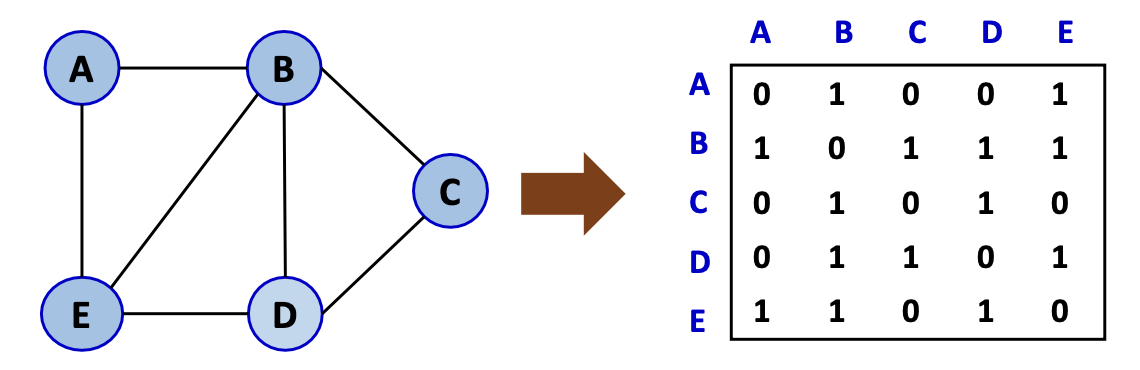
1. Create a Matrix(e.g. use a 2-dimensional array)
2. Any index i represents a node
3. Any entry (i, j) in the matrix represents connectivity between two nodes i, j
1. entry (i, j) = 1 => an edge exists
2. entry (i, j) = 0 => no edge exists
Adjacency List Representation
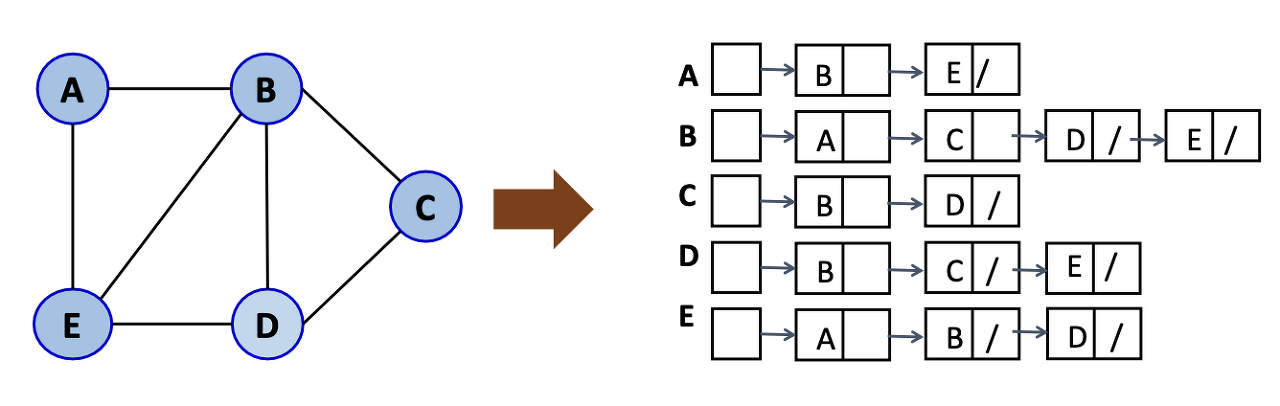
1. Create an array of Lists (e.g. use a linked-list)
2. The headers of the lists represents the nodes
3. Every list represents the nodes, connected from the header node
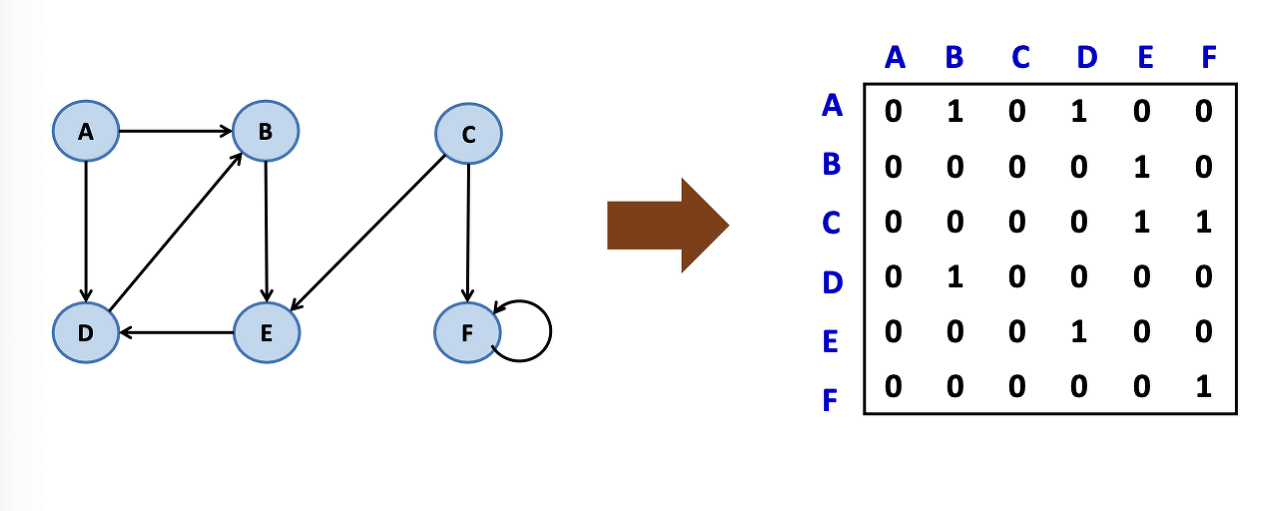
Adjacency Matrix for Directed Graph
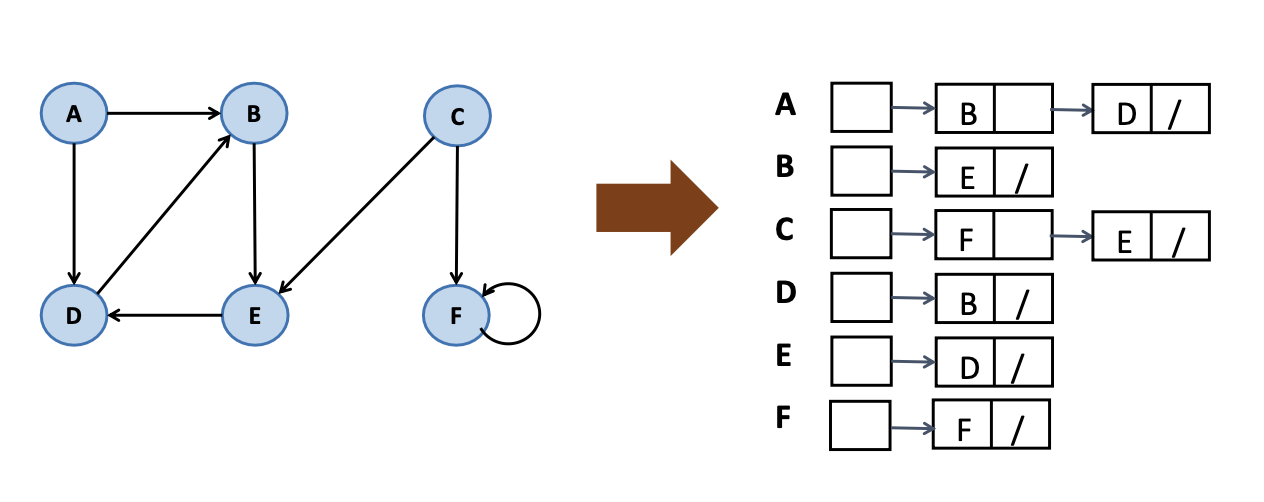
Adjacency List for Directed Graph
Breadth-First Search (BFS Traversal)
- Start from the starting node (this will be given to you)
- Generate a traversal tree while traversing the graph
- A node is traversed when its all successor nodes are generated
- use queue
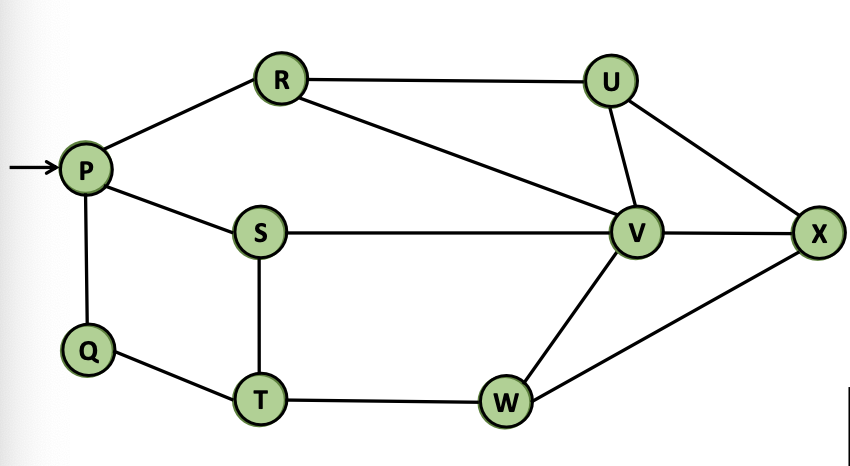
- Traversed List : PQRSTVUWX
Depth-First Search (DFS Traversal)
- Same as with tree traversal using DFS
- Use a stack
- use Boolean visited arrary
Five components of Greedy Algorithms
- candidate set : From which a solution is created
- selection function : chooses the best candidate to be added to the solution
- Feasibility function : Determines if a candidate can be used to contribute to a solution
- Objective function : Assigns a value to a solution, or a partial solution
- Solution function : indicates when we have discovered a complete solution
Shortest path algorithms : Major components
Initialize-Single-Source (G, s)
for each vertex v ε G
	v.dist ← ∞
	v.π ← NULL
	s.dist ← 0
Relax (u, v, w)
if v.dist > (u.dist + w(u, v))
v.dist ← u.dist + w(u, v)
v.π ← uDijkstra's Algorithm
1. Set 1: S = ∅
2. Set 2: Q = V[G]
3. While Q != ∅
  u = extractMin(Q)
  S = S U {u}
	for each 𝑣 ∈ 𝐴𝑑𝑗 𝑢 & Not in Q
    if (d[v] > d[u] + w)
	d[v] = d[u] + w
    Parent[v] = u
Spanning Tree
- sub-graph that connects all the vertices together using the minimum number of edges required
- There should be no cycles
- for n number of vertices, (n-1) edges are needed
Minimum Spanning Tree(MST)
- cost of any spanning tree : add weights of all the edges
- MST : a tree with minimum weights is MST
- Time complexity : Exponential
Prim's Algorithm : at a glance
- two sets
- MST set: vertices that are included in the spanning tree
- set2 : vertices that are not yet included in the spanning tree
- Create an array of size V and initialize it with NIL
- Create a Priority Queue(min Heap) of size V. Let the min Heap be Q
- Inser all vertices into Q. Assign cost of starting vertex to 0 and the costs of other vertices to infinite.
MST-PRIM(G, w, source)
for each u Є V [G] do // for all vertices
	cost[u] ← ∞
	π[u] ← NULL
cost[source]<;-0
Q←V[G]//set2
while Q ≠ Ø do
	u ← EXTRACT-MIN(Q)
    for each v Є Adj[u] do
		if v Є Q and w(u, v) < cost[v]
        	π[v] ← u
			cost[v] ← w(u, v)
application
- reducing copper to connect multiple nodes in a electrical/electronic circuit
- minimizing network length (cable cost) to connect multiple routers/computers etc.
'Computer Science > Data Structure' 카테고리의 다른 글
| Heaps (0) | 2023.08.09 |
|---|---|
| Hashing (0) | 2023.08.09 |
| Binary Search Tree(BST) (0) | 2023.08.09 |
| Trees (0) | 2023.08.09 |
| Linked List (0) | 2023.08.09 |
'Computer Science/Data Structure' Related Articles
more


